What a Taita Is — and Why Lineage Isn't a Marketing Word

Updated: Oct 14
"Shaman" appears on almost every ayahuasca website in Europe. It is a word with no gatekeeper. Nobody grants it, nobody withdraws it, and anyone can print it on a page.
Taita is different, and the difference is the whole point.
The word
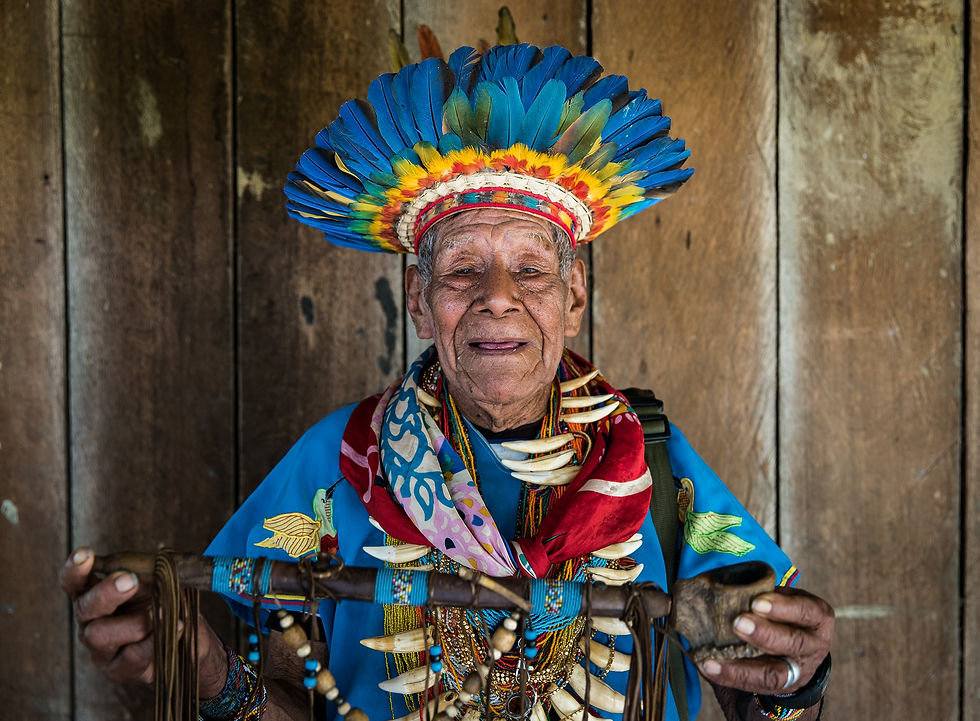
Taita means father. In the yagé traditions of Putumayo and the Sibundoy Valley — among the Cofán, Inga, Kamëntsá, Siona and Coreguaje peoples — it is the term of respect for a male elder who carries the medicine.
It is not an occupation. It is a standing within a community, and communities are what confer it.
You cannot decide to be a taita. You can decide to call yourself a shaman this afternoon.
How the role is actually acquired
Not through a course. Not through a certification. Not through a number of ceremonies attended.
In the Cofán tradition, authority comes through years — frequently decades — of apprenticeship under a senior taita. The apprentice drinks, learns the songs and the prayers, learns to prepare the medicine, and is progressively trusted with more of the ceremony. Among the Cofán specifically, the healer's power is understood to be acquired through long submission to what is encountered in the medicine itself, over a very long time.
Taitas also keep gardens of medicinal and visionary plants, which is a detail worth pausing on. The knowledge is not only ceremonial. It is agricultural, botanical, and tied to a specific piece of land.
That is the part that cannot be exported: you can learn songs anywhere, but you cannot learn a plant garden in Putumayo from Barcelona.
What the taita is doing during a ceremony
From the outside it can look like singing. It is considerably more than that.
Deciding the dose. Individually, for each person, based on reading them. Not a standard measure.
Holding the space energetically. In the tradition's own terms — opening it, protecting it, closing it.
Steering with music. The songs are not accompaniment. They direct the ceremony, lift people who are stuck, slow people who are running.
Reading the room. Knowing who is working, who is struggling, who needs to be left alone and who needs to be reached.
Individual work. In many ceremonies the taita works directly with individuals during the night.
The skill is largely invisible if you do not know what to look for, which is precisely why the market can get away with substituting someone who has a playlist.
Why lineage functions as accountability
Here is the practical argument, stripped of romance.
Lineage means there is somebody outside the business who can withdraw their name.
A self-appointed facilitator answers to nobody. A taita answers to the elders who trained him, to his community, and increasingly to organised bodies — in 1999 the Cofán, Inga, Kamëntsá, Siona and Coreguaje founded UMIYAC, the Union of Indigenous Yagé Healers of the Colombian Amazon, explicitly to protect the tradition and its healers from misuse.
That is an external check. In a field with no regulator, external checks are the only structure available.
Lineage is not about authenticity. It is about who can say no to you.
Which makes the European question uncomfortable
And it should be, so let me put it plainly rather than defensively.
The Cofán have publicly challenged organisations claiming that their knowledge can legitimately be held outside proper lineage. That challenge applies to European retreat centres — including, potentially, to us. It is not a criticism we can dismiss by pointing at our intentions.
The only honest response is a relationship rather than a claim. Ours with the Cofán community of Putumayo has run since 2017. The taitas travel and sit with us; we go there. We run retreats in Colombia as well as in Spain, and money moves in both directions.
That is not a resolution of the tension. It is a way of remaining answerable inside it.
What to ask any centre claiming lineage
Five questions. The answers separate relationship from vocabulary very quickly.
Which tradition, and which community? "Indigenous wisdom" is not an answer. Cofán, Shipibo, Kamëntsá, Huni Kuin are.
Who is the taita or maestro by name, and who trained them?
How long has this relationship existed? Years, not "a while."
Do they travel to you, or do you only travel to them? Both directions is a stronger signal than either alone.
What flows back to the community? A specific answer or an evasive one — and the evasion is the answer.
You are not being difficult. You are asking a centre to demonstrate that a word on its homepage corresponds to something in the world.
More on the Cofán yagé tradition of Putumayo, and on who we are and how we work.
Ritshi Zenati, Speaker & Life Coach
Founder at Holistika Center.
Holistika Center holds plant medicine retreats across Barcelona, Málaga, Mallorca, Switzerland, Germany, Norway, Colombia and Mexico.
Also, different programs like Microdosing, Life and Spiritual Guidance, etc.
Visit Holistika Center to explore upcoming programs.


Comments