Yagé and Ayahuasca: What the Cofán Tradition

Updated: Oct 14
Short answer. Yagé is the Colombian name for the medicine known in Peru as ayahuasca. Both are built on the Banisteriopsis caapi vine, but Colombian yagé typically uses chagropanga (Diplopterys cabrerana) as its DMT-bearing admixture rather than Peruvian chacruna, is prepared with the vine bark stripped away, and is served in ceremonies led by a taita that build toward dawn rather than peaking before midnight. The tradition belongs to the Cofán, Inga, Kamëntsá, Siona and Coreguaje peoples of Putumayo and the Sibundoy Valley. Holistika Center has worked in the Cofán tradition since 2017.
Almost everything written in English about ayahuasca describes a Peruvian ceremony: Shipibo icaros, a maloca near Iquitos, chacruna in the brew, the deepest hours somewhere before midnight.
That is one tradition. It is not the one we work in, and the differences are large enough that if you are choosing where to sit, they should inform the choice.

What is the difference between yagé and ayahuasca?
They are the same family of medicine under two names, and the names mark real regional differences in plant, preparation and ceremony.
Ayahuasca is a Quechua word, usually rendered as "vine of the soul" or "vine of the dead." Yagé comes through the languages of the Colombian and Ecuadorian Amazon. Using the second word signals a specific ceremonial world rather than a translation preference.
Peruvian ayahuasca | Colombian yagé | |
Vine | Banisteriopsis caapi | Banisteriopsis caapi |
Admixture | Chacruna (Psychotria viridis) | Chagropanga / chaliponga (Diplopterys cabrerana) |
Vine preparation | Often boiled with bark on | Pounded, bark stripped before boiling |
Ceremony peak | Roughly 10pm to midnight | Builds late; often 3am to sunrise |
Music | Icaros, largely unaccompanied | Harmonica, guitar, live singers |
Framing | Madre Ayahuasca — mother | Abuelo Yagé — grandfather |
Ceremonial leader | Curandero, maestro, shaman | Taita |
The admixture
Chagropanga is a vine rather than a shrub, and carries a higher DMT content by weight than chacruna, with a different alkaloid balance. Content varies substantially with growing conditions and preparation, so any precise figure quoted online — including any you find here — should be treated with caution.
The preparation, which may matter more
In the Colombian tradition the vine is typically pounded and the outer bark removed before boiling, leaving mainly the inner wood. That produces a brew with far fewer tannins, and tannins are a major driver of vomiting. Where the bark is left on, the brew is markedly more purgative.
So one of the most noticeable practical differences between the two traditions comes not from the DMT plant at all, but from how the vine was processed. Participants who have sat in both frequently describe Peruvian ayahuasca as opening faster and more visually, and Colombian yagé as heavier in the body, slower to build and longer. I have heard this often enough to think there is something in it, while remaining cautious about attributing it to any single variable.
Which peoples hold the yagé tradition?
Yagé belongs to specific communities across Putumayo, Caquetá and the Sibundoy Valley in southern Colombia, extending across the border into Ecuador. The five most closely associated are:
Cofán (A'i Kofán) — whose territory straddles the Colombia–Ecuador border. The tradition Holistika Center works in.
Inga — Quechua-speaking, of the Sibundoy Valley
Kamëntsá (also written Camsá or Kamsá) — of the Sibundoy Valley, speakers of a language isolate unrelated to any other known language
Siona — of the lower Putumayo, whose practice was extensively documented by anthropologist E. Jean Langdon
Coreguaje
In 1999 these peoples founded UMIYAC — the Unión de Médicos Indígenas Yageceros de la Amazonía Colombiana, the Union of Indigenous Yagé Healers of the Colombian Amazon — specifically to protect the tradition, its healers and their territories from misuse and commercial appropriation.
That is not historical background. It is the governing context for anyone, anywhere, running yagé ceremonies today.
What is a taita?
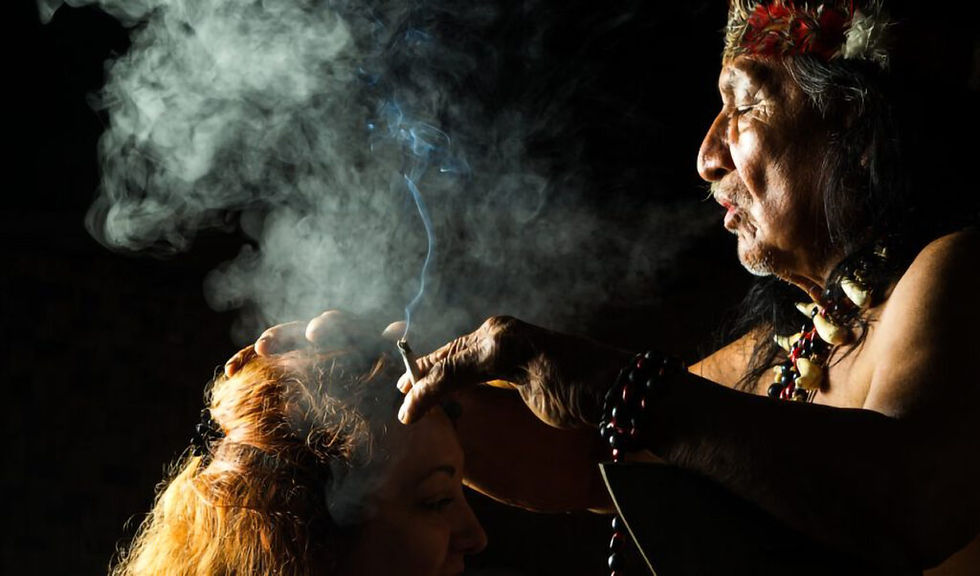
In the Colombian tradition the ceremonial leader is not called a shaman. He is called a taita — literally "father."
The word is not decorative, and the distinction is practical rather than romantic. "Shaman" has no gatekeeper: nobody grants it, nobody can withdraw it, and anyone can print it on a website this afternoon. "Taita" is a standing conferred by a community, which means it can be revoked by one.
Authority is acquired through years — frequently decades — of apprenticeship under senior taitas. The apprentice drinks, learns the songs and prayers, learns to prepare the medicine, and is progressively trusted with more of the ceremony. Among the Cofán specifically, a healer's power is understood to come through long submission to what is encountered in the medicine itself, over a very long time.
Taitas also maintain gardens of medicinal and visionary plants. That detail is worth pausing on, because it is the part that cannot be exported. Songs can be learned anywhere. A plant garden in Putumayo cannot be learned from Barcelona.
What the taita is doing during ceremony
Setting each person's dose individually, by reading them — not by a standard measure
Opening, holding and closing the space in the tradition's own terms
Steering with music. The songs direct the ceremony, lift people who are stuck, slow people who are running
Reading the room — who is working, who is struggling, who should be left alone
Working directly with individuals during the night
Most of this is invisible if you do not know what to look for, which is precisely why the market can substitute someone with a playlist and few people notice.
What is a Cofán yagé ceremony like?
Beyond the brew, four things distinguish it from the Peruvian model most readers will have encountered.
It builds late
Ceremonies open after dark, but the deepest hours tend to fall between three in the morning and sunrise. In the tradition, that late window is understood as when the work is done. People arriving with Peruvian expectations sometimes conclude at midnight that little is happening — and then meet the ceremony at four.
The music is live and instrumental
Where Peruvian ceremonies centre on sung icaros, Colombian ceremony carries harmonica, guitar and the taita's own songs, alongside singers and musicians. Holistika Center keeps live music throughout every ceremony for this reason: in this lineage the music is not atmosphere, it is the instrument the space is steered with.
Grandfather, not mother
Peruvian traditions commonly speak of Madre Ayahuasca. Colombian traditions more often speak of Abuelo Yagé. It sounds like a small semantic difference and it changes the posture you arrive in — less surrender to a mother, more sitting before an elder who will tell you something you may not want to hear.
Tobacco runs through it
Sacred tobacco — as hapé or rapé snuff, as ambil paste, as mapacho — is woven through Colombian ceremony as a grounding and clearing agent rather than an occasional addition.
The uncomfortable question: yagé in Europe
If the tradition belongs to Putumayo, what is it doing in Barcelona?
This is a real tension and I do not think it should be smoothed over, so let me state the strongest version of the objection. The Cofán have publicly challenged organisations claiming that their knowledge can legitimately be held outside proper lineage. That challenge applies to European retreat centres, potentially including this one. It is not something we can dismiss by pointing at our intentions.
The only honest answer is a relationship rather than a claim. Our collaboration with the Cofán community of Putumayo has run since 2017. The taitas travel and sit with us in Europe; we travel and sit with them in Colombia. We run retreats in Colombia as well as in Spain, Switzerland and elsewhere, and money moves in both directions.
That does not resolve the tension. It is a way of remaining answerable inside it.
The alternative — European facilitators serving brew with borrowed vocabulary and no living relationship behind it — is precisely what UMIYAC was formed to resist.
How to test a lineage claim
Ask any centre claiming a tradition these five questions. The answers separate relationship from vocabulary very quickly.
Which tradition and which community? "Indigenous wisdom" is not an answer. Cofán, Shipibo, Kamëntsá, Huni Kuin are.
Who is the taita or maestro by name, and who trained them?
How long has the relationship existed? In years, not "a while."
Do they travel to you, or do you only travel to them? Both directions is a stronger signal than either alone.
What flows back to the community? You will get a specific answer or an evasive one, and the evasion is itself the answer.
Lineage is not about authenticity. It is about whether there is anyone outside the business who can withdraw their name.
Frequently asked questions
Is yagé the same as ayahuasca?
Yagé is the Colombian name for the same family of medicine called ayahuasca in Peru. Both are built on the Banisteriopsis caapi vine, but Colombian yagé typically uses chagropanga rather than chacruna as its DMT-bearing admixture, is prepared with the vine bark stripped, and is served in a distinct ceremonial form.
What does taita mean?
Taita means "father" and is the term of respect for a male elder who carries the yagé medicine among the Cofán, Inga, Kamëntsá, Siona and Coreguaje peoples. It is conferred by a community after years or decades of apprenticeship, unlike "shaman," which anyone can adopt.
Is Colombian yagé stronger than Peruvian ayahuasca?
Not straightforwardly. Chagropanga carries more DMT by weight than chacruna, but strength depends more on how far the brew was reduced during cooking and on the dose the taita gives. Participants more often describe yagé as heavier in the body and slower to build than as simply stronger.
Why does Colombian yagé cause less vomiting?
Because the vine bark is typically stripped before boiling. Bark carries tannins, and tannins are a major driver of purging. Brews boiled with the bark on tend to be substantially more purgative.
What is UMIYAC?
The Union of Indigenous Yagé Healers of the Colombian Amazon, founded in 1999 by the Cofán, Inga, Kamëntsá, Siona and Coreguaje peoples to protect the yagé tradition, its healers and their territories from misuse and commercial appropriation.
Can yagé ceremonies be held outside Colombia?
They are, including by Holistika Center in Europe, and it remains a genuine point of contention. The Cofán have publicly challenged organisations claiming their knowledge can be held outside proper lineage. The meaningful distinction is between centres with a living, reciprocal relationship to a named community and those using the vocabulary decoratively.
You can read more about the Cofán yagé tradition of Putumayo, or see how a retreat with us is structured.
Ritshi Zenati, Speaker & Life Coach
Founder at Holistika Center.
Holistika Center holds plant medicine retreats across Barcelona, Málaga, Mallorca, Switzerland, Germany, Norway, Colombia and Mexico.
Also, different programs like Microdosing, Life and Spiritual Guidance, etc.
Visit Holistika Center to explore upcoming programs.


Comments